


With the development of high-end manufacturing, precision manufacturing processes have gradually become an important standard for measuring the technological level of a processing enterprise. Among many advanced manufacturing equipment, the five-axis CNC machining center is widely recognized as one of the core pieces of equipment in the field of precision manufacturing. Many people have heard of five-axis machining, but do not truly understand its manufacturing capabilities and its practical significance in precision machining.
The essence of precision manufacturing processes lies in achieving a balance between high precision, high consistency, and high complexity. Traditional three-axis CNC machining centers can only move in three linear directions (X, Y, and Z). When encountering complex curved surfaces or multi-angle structures, they often require multiple clamping and repeated positioning, resulting in low machining efficiency and easy accumulation of errors, making it difficult to meet the precision and surface quality requirements of high-end parts.
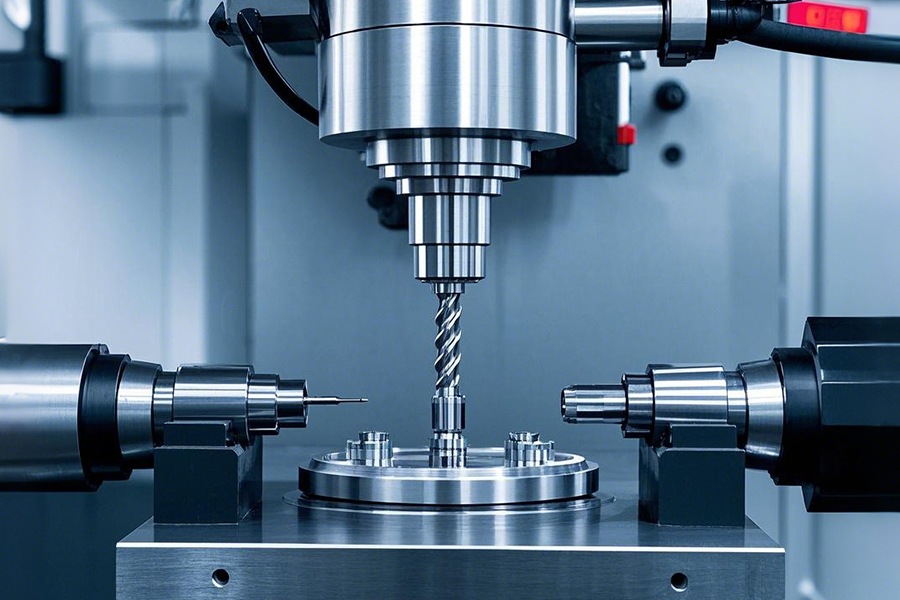
The five-axis CNC machining center adds two rotary axes to the three-axis system, enabling the tool or workpiece to achieve simultaneous machining at any angle in space. This structural change allows the machine tool to maintain the optimal cutting posture throughout the machining process, thereby significantly improving machining capabilities. For complex curved surface parts, five-axis machining can complete multi-faceted or even full-contour machining in a single clamping, greatly reducing clamping errors and improving dimensional accuracy and consistency.
From a manufacturing capability perspective, the most prominent advantage of five-axis CNC centers lies in their ability to machine complex parts. For example, parts such as aero-engine blades, impellers, medical implants, and high-end mold cavities often have continuously varying spatial surfaces and stringent precision requirements. Five-axis simultaneous machining allows the tool to smoothly cut along the optimal path, reducing tool marks caused by layered machining and significantly improving the surface quality of the parts.
In terms of precision control, five-axis machining effectively reduces the accumulation of human error and systematic errors by reducing the number of repeated clamping and positioning operations. This is especially important for parts with micron-level tolerances. Furthermore, multi-axis simultaneous machining allows for real-time compensation through the CNC system, ensuring stable machining accuracy even during complex movements.
Many people believe that five-axis machining necessarily means low efficiency and high cost, but in actual production, the opposite is true. Because five-axis machining can reduce the number of processes, shorten machining paths, and achieve higher feed rates, its overall efficiency and comprehensive cost are often superior to traditional machining methods in the manufacture of small-batch, high-value-added parts. In addition, better surface quality also means a significant reduction in subsequent polishing and finishing processes, further improving production efficiency.
It’s important to note that the manufacturing capabilities of a five-axis CNC center depend not only on the equipment itself. The machine tool’s rigid structure, high-precision CNC system, mature five-axis programming technology, and comprehensive testing methods together constitute a complete precision manufacturing system. Only when processes, equipment, and operational experience are in sync can the advantages of five-axis CNC machining be truly realized.
From an industry application perspective, five-axis precision manufacturing has become an indispensable technological support for aerospace, medical devices, high-end automotive parts, precision molds, and new energy equipment. As five-axis CNC technology continues to mature and become more widespread, its application threshold is gradually decreasing, extending from a few high-end fields to a wider range of manufacturing scenarios.
Overall, a five-axis CNC machining center is not simply “high-end equipment,” but rather a comprehensive embodiment of modern precision manufacturing capabilities. In today’s pursuit of complex structures, high precision, and high reliability, five-axis precision manufacturing is gradually becoming an inevitable trend in the development of advanced manufacturing.