

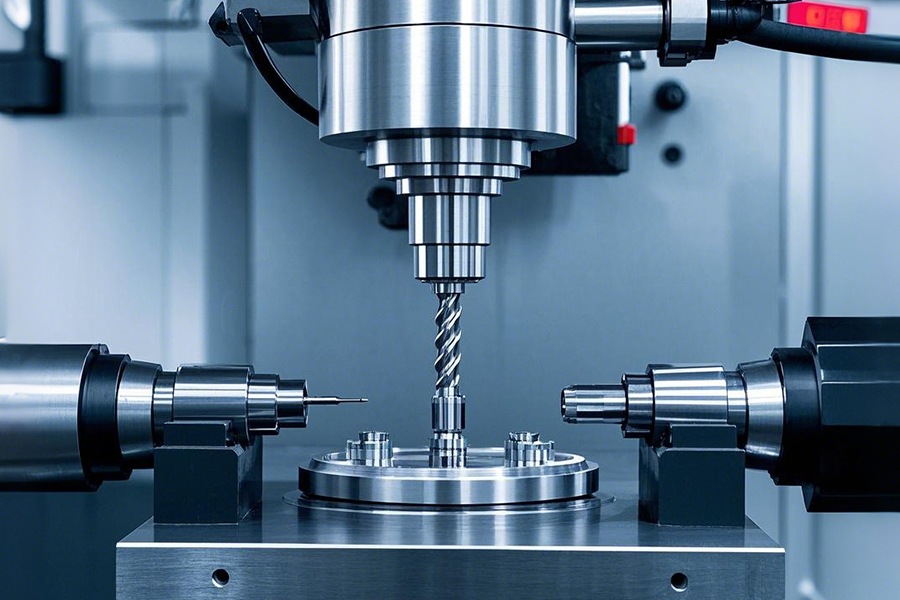


In the field of precision machining, traditional cutting processes are prone to problems such as tool wear and insufficient precision when dealing with high-hardness parts (HRC60 and above), brittle materials, and complex irregular structures. Electrical discharge machining (EDM), as a core technology in special precision machining, focuses on “non-contact energy abrasion.” It removes material using electrical, thermal, and chemical energy, eliminating the need for direct contact between the tool and workpiece. This has become a key supporting technology in high-end fields such as mold making and aerospace.
Unlike traditional turning and milling, which rely on cutting forces, EDM uses controllable non-mechanical energy to melt, vaporize, or electrochemically dissolve the workpiece material. This eliminates the limitation of matching the hardness of the tool and workpiece, enabling efficient machining of high-hardness, brittle, and complex irregular parts. Especially in mold making, it ensures micron-level precision while improving the efficiency of machining complex surfaces, making it a core process.

Key Features: Adaptable to High-Difficulty Machining
Electrical Discharge Machining (EDM) is characterized by “non-contact, low cutting force, high precision, and wide adaptability.” It differs from traditional cutting processes in three key ways: First, it’s non-contact machining, avoiding workpiece deformation caused by cutting forces, making it suitable for thin-walled, precision parts with micron-level accuracy. Second, it’s not limited by workpiece hardness, solving machining challenges with high-hardness alloys and ceramics, and avoiding the problem of rapid tool wear. Third, it offers high machining flexibility, completing complex cavities and deep grooves without complex tools, reducing costs and time.
Three Mainstream Processes: Adaptable to Different High-End Machining Scenarios
Electrical Discharge Machining (EDM): A Powerful Tool for Complex Cavity Machining
EDM relies on high-frequency electrical discharge between the electrode and the workpiece to generate temperatures exceeding 10,000 degrees Celsius, melting and vaporizing the material. The electrode and workpiece maintain a tiny discharge gap, eliminating the need for contact. It excels at machining complex surfaces, adapting to structures such as plastic mold cavities and die-casting mold cores. It offers high machining accuracy and excellent surface roughness, requiring no additional polishing, and is widely used in various mold manufacturing and the machining of complex structures from high-hardness alloys.
Wire Electrical Discharge Machining (WEDM): Precision Machining of Irregular Shapes
WEDM is similar in principle to EDM, but uses a continuously moving metal wire as the electrode to achieve contour cutting. It is divided into fast wire EDM and slow wire EDM. Fast wire EDM is highly efficient and low-cost, suitable for machining medium-to-low precision irregular shapes; slow wire EDM achieves IT6 precision and a surface roughness Ra≤0.2μm, suitable for precision molds and aerospace precision irregular shapes. It requires no complex electrodes and can quickly machine two-dimensional irregular contours through programming, making it an important process for precision parts machining.

Electrochemical Machining (ECM): Preferred for Machining Large, High-Hardness Parts
ECM uses an electrolytic reaction to remove material. The workpiece is placed as the anode and the tool as the cathode in an electrolyte solution, and the material is electrochemically dissolved by a DC voltage. It has no cutting force, no thermal deformation, and high efficiency, making it suitable for batch machining of large, high-hardness parts. It can handle materials such as high-hardness heat-resistant alloys and is widely used in the machining of high-end components such as aero-engine blades and gun barrel rifling, meeting stringent precision requirements.
Currently, the three major processes each perform their respective functions and complement each other, covering high-end processing needs in multiple fields. As high-end manufacturing demands higher precision, efficiency, and complexity in parts, electrical discharge machining (EDM) technology will continue to upgrade, helping my country’s manufacturing industry transform towards precision, high-end, and intelligent manufacturing.