

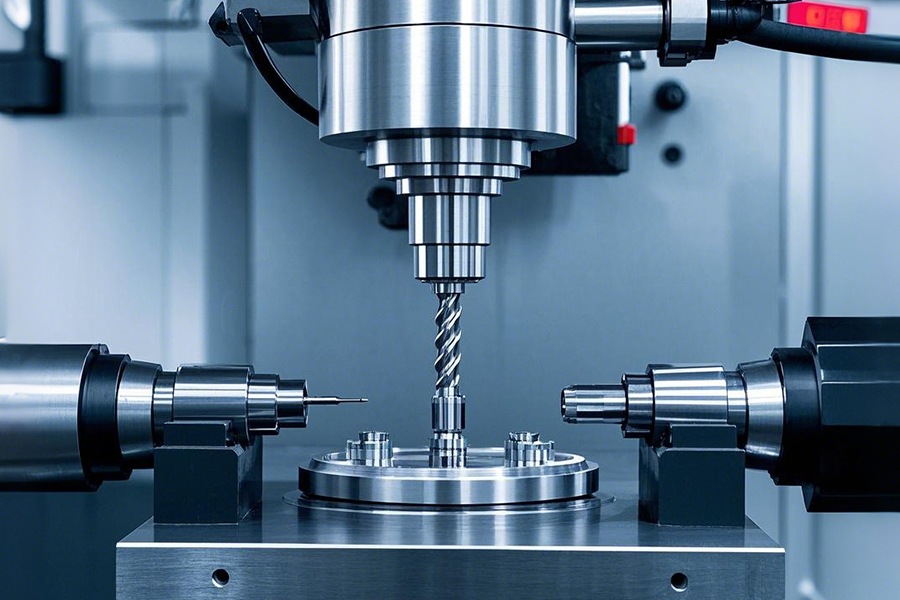


In the manufacturing of medical device components, key parts such as the joint through-holes of surgical instruments and sensor assembly holes of diagnostic devices have extremely stringent standards for hole structure precision and consistency. Even a slight deviation of just a few micrometers in the size of these holes can directly impact the clinical effectiveness of medical devices, potentially posing a threat to patient safety.
In the field of life sciences research, core components of laboratory instruments, such as the tubing interface holes of bioreactors and rotor positioning holes of centrifuges, also require stable and reliable hole machining quality to ensure the sealability of fluid transmission and precision during high-speed operations.
However, traditional machining methods using standard drilling machines often face significant problems, such as insufficient machining precision, large repetitive machining errors, and difficulty in achieving precise complex hole systems. Additionally, various uncertainties in manual operations can lead to significant quality fluctuations within the same batch of workpieces, making it difficult to meet the strict standards for component machining in medical and life sciences fields.

Faced with these challenges, achieving breakthrough solutions for high-precision and high-consistency hole machining has become a key issue for industry development. The application of drilling-boring technology provides a practical and feasible technical path to solve this common problem.
Core Definition and Technical Mechanism of Drilling-Boring Process
The drilling-boring process is an advanced precision machining method that integrates digital control technology. It uses computer programs to precisely control key factors such as machine tool motion paths, tool specifications, and machining cycles to efficiently complete both drilling and boring operations. The core technical mechanism of this process relies on the system’s powerful command interpretation capabilities, which convert hole system parameters from design drawings into machine-readable and executable motion path commands.
These commands drive the spindle and worktable to achieve coordinated movement, ensuring that parameters such as tool positioning, depth, and diameter on the workpiece surface strictly meet design specifications. Compared to traditional manual or semi-automatic machining methods, this process fundamentally eliminates errors introduced by human operations and significantly enhances the precision and stability of hole machining. It efficiently adapts to the machining needs of various complex hole systems, making it especially suitable for large-scale production of high-precision components.
Core Advantages of Drilling-Boring Process Compared to Traditional Machining
Traditional hole machining processes often require the use of both drilling machines and boring machines, involving complex procedures and the risk of positioning errors during workpiece re-clamping, which affects machining precision. In contrast, the advantages of the drilling-boring process are more prominent, mainly reflected in four aspects:
- Superior Machining Precision: It achieves micron-level precision, perfectly matching the extreme hole machining precision requirements of medical device components.
- Significant Efficiency Improvement: The integration of drilling and boring operations reduces time spent on workpiece handling and re-clamping, and with automatic feeding, it further optimizes the overall machining pace, shortening production cycles.
- Outstanding Ability for Complex Hole Systems: The process can easily handle tasks such as drilling inclined holes, deep holes, and irregularly shaped holes that are difficult to achieve with traditional machining methods, thus meeting the needs of more specialized structural components.
- Excellent Consistency: The digital control mode effectively avoids uncertainties introduced by manual operations, controlling quality deviations in the same batch of workpieces within a minimal range, fully meeting the mass production and standardization requirements of the medical and life sciences sectors.

Specific Application Scenarios of Drilling-Boring Process in Key Fields
The core applications of the drilling-boring process focus on the manufacturing of medical device components and life sciences laboratory instrument parts, while also extending to other high-precision manufacturing industries.
- Medical Device Manufacturing: This process is widely used in machining critical components such as connection holes for surgical instruments, through-holes for endoscopic catheters, and positioning holes for dental implants. By precisely controlling hole size and positional accuracy, it ensures the assembly precision of medical device parts, guaranteeing the safety and reliability of clinical use.
- Life Sciences Field: It is used for machining components like rotor holes for laboratory centrifuges, stirring shaft holes for bioreactors, and tubing interface holes for chromatographs. This effectively ensures the stability and precision of instruments during fluid transmission and high-speed operation, supporting the accuracy of scientific research experiments.
In addition, the drilling-boring process is also widely applied to machining core components in aerospace engines, precision parts in automotive transmissions, and electronic chip cooling components, providing critical technical support for high-end precision manufacturing across various industries.
Machining Effect and Key Points for Quality Control in Drilling-Boring Process
The machining effect of the drilling-boring process is primarily reflected in two core dimensions: hole geometric precision and surface quality.
Geometric precision includes key indicators such as hole roundness, perpendicularity, and coaxiality, which directly determine the fit of the component during assembly.

Surface quality focuses on the roughness and burr-free requirements of the hole inner wall, particularly for medical components, where burrs must be avoided to prevent adverse effects on human tissue or instrument operation. To ensure machining quality, four core aspects must be carefully controlled:
- Scientific Selection of Tools: Tools must be selected based on the material of the workpiece (e.g., stainless steel, titanium alloy, engineering plastics) to match the appropriate drill bits and boring tools, minimizing tool wear and its impact on machining precision.
- Optimization of Machining Parameters: Reasonably adjusting machine speed, feed rate, coolant usage, and other parameters helps effectively reduce tool wear rates and avoid deformation of workpieces during machining.
- Real-Time Monitoring: Machine tools equipped with sensors can monitor machining parameters in real time, allowing for timely adjustment of deviations and achieving closed-loop control of the machining process.
- Post-Processing Steps: Specialized deburring and cleaning processes ensure that components meet stringent hygiene standards required in the medical and life sciences fields.
Market Development Trends and Core Value of Drilling-Boring Process
Currently, the demand for the global precision manufacturing industry continues to rise, with the demand for high-precision components in medical devices and life sciences fields maintaining a high compound annual growth rate. This provides a broad market space for the development of the drilling-boring process. In the future, the development of the drilling-boring process will steadily progress towards intelligence and automation, such as introducing artificial intelligence technology to optimize machining parameters and achieving autonomous regulation and unmanned production.
At the same time, green manufacturing will become an important development direction, with technology upgrades reducing the use of cutting fluids and energy consumption, enabling the coordinated development of environmental protection and efficient machining. The core value of this process lies not only in significantly improving the efficiency and quality of precision hole machining, solving the industry pain points of traditional machining but also in driving technological innovation in the medical and life sciences fields. It provides core technical support for the domestic substitution of high-end medical equipment and laboratory instruments, helping relevant manufacturing enterprises enhance their core competitiveness.
As one of the core machining technologies in precision manufacturing, the drilling-boring process has successfully solved industry challenges such as insufficient hole machining precision and poor consistency, thanks to its digital control and integrated operation advantages. Its deep application in manufacturing medical device components and life sciences parts has provided high-quality, high-consistency hole machining solutions for these two fields, establishing a solid technical foundation for high-end precision manufacturing.
For manufacturing enterprises in the medical and life sciences fields, mastering the core technology of the drilling-boring process or choosing a professional drilling-boring service provider is key to improving product quality and enhancing market competitiveness. With continuous technological upgrades and iterations, the drilling-boring process will continue to play a core supporting role, helping the precision manufacturing industry achieve high-quality development and injecting new momentum into technological progress in the medical and life sciences fields.